
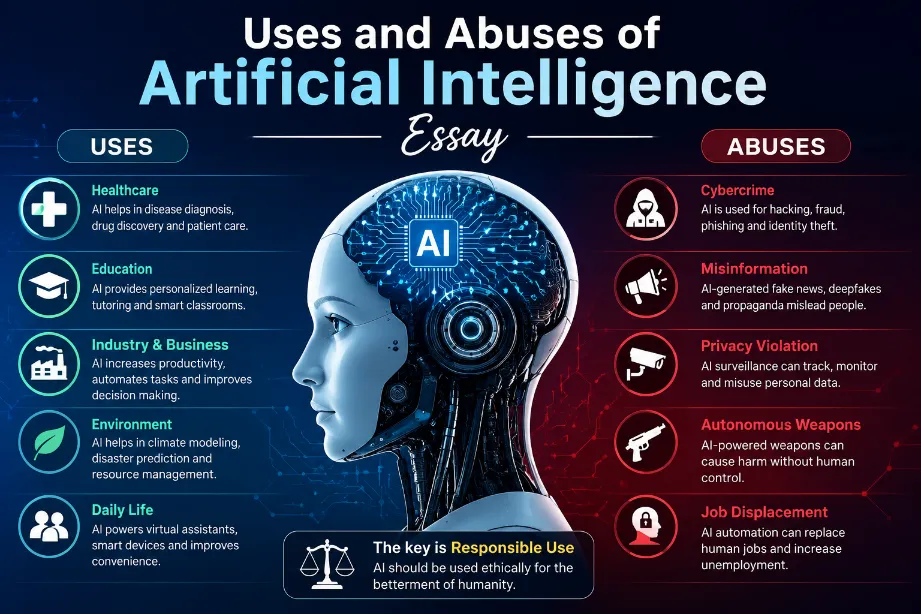
Artificial Intelligence, commonly called AI, has changed the way we study, work, communicate, travel, shop, and use digital services. Computers can now process large amounts of data, answer questions, create images, assist with research, detect unusual activity, and support many daily tasks.
AI offers many useful benefits, yet careless use can create serious problems. Its value depends on the purpose behind its use, the quality of information it receives, and the way humans control its decisions.
Uses of Artificial Intelligence
Artificial Intelligence has practical uses in almost every major field. It helps doctors examine medical data, assists teachers with learning material, supports farmers with crop monitoring, and gives businesses tools for customer service.
Some major uses are given below:
- Education: AI can help students with explanations, grammar, research ideas, practice questions, and personalized learning.
- Healthcare: AI systems can assist doctors in reviewing scans, medical records, and test results.
- Agriculture: Farmers can use AI tools to monitor crops, weather conditions, soil data, and irrigation needs.
- Banking: Banks use automated systems to detect unusual transactions and reduce financial fraud.
- Transportation: AI supports route planning, traffic management, driver assistance, and vehicle safety systems.
- Business: Companies use AI for customer support, data analysis, forecasting, and routine office tasks.
- Communication: Translation and speech-recognition tools make communication easier across different languages.
- Entertainment: AI can recommend films, songs, games, and other digital content based on user activity.
- Security: AI can identify suspicious patterns in digital systems and help security teams respond to threats.
- Accessibility: Voice assistants, speech-to-text tools, and image descriptions can support users with different abilities.
Artificial Intelligence in Education
AI has created new possibilities for students and teachers. A learner can use an AI assistant to receive a simple explanation of a difficult mathematical problem or practice English grammar.
Teachers can also use digital tools to prepare quizzes, organize lesson material, generate examples, and provide basic feedback.
AI can support education through:
- Personalized study exercises
- Language translation
- Grammar correction
- Research assistance
- Practice tests
- Writing support
- Educational chatbots
- Speech and reading assistance
Students still need to complete their own academic work. Copying AI-generated answers without learning the subject can weaken writing skills, creativity, and independent reasoning.
Artificial Intelligence in Healthcare
Healthcare provides one of the most useful areas for AI. Modern systems can process medical information at a speed that would take humans much longer.
AI may assist with:
| Area | Use of AI |
|---|---|
| Medical imaging | Helps examine X-rays, CT scans, and other images |
| Patient records | Helps organize large amounts of medical data |
| Drug research | Supports analysis during medicine development |
| Monitoring | Tracks selected patient data |
| Diagnosis support | Gives doctors additional information for assessment |
| Hospital management | Helps manage schedules, beds, and administrative tasks |
AI should support medical professionals rather than replace professional judgment. A medical decision requires clinical experience, patient history, physical examination, and other evidence.
Artificial Intelligence in Daily Life
Many AI systems work quietly during normal daily activities. Search engines provide relevant results, smartphone cameras improve photographs, map applications suggest routes, and online stores recommend products.
Common examples include:
- Voice assistants
- Spam filters
- Face recognition
- Online recommendations
- Smart cameras
- Translation applications
- Navigation systems
- Email sorting
- Fraud alerts
- Automated customer support
These tools can save time and reduce repetitive work.
Abuses of Artificial Intelligence
Artificial Intelligence can also cause harm through irresponsible or dishonest use. The same technology that helps create useful content can also produce false information, fake images, misleading videos, and deceptive messages.
Major abuses include:
- Creating fake photographs or videos
- Spreading false information
- Producing fake voices
- Cheating in examinations
- Generating misleading academic work
- Impersonating another person
- Conducting automated scams
- Collecting private data without proper permission
- Manipulating online opinions
- Creating harmful computer programs
- Producing deceptive advertisements
- Making fraudulent documents
Such misuse can damage trust and cause financial, social, or personal harm.
Deepfakes and False Content
Deepfake technology can create realistic images, videos, or audio using AI. A person’s face or voice may appear in material that they never created.
This creates problems for:
- Personal reputation
- Journalism
- Elections
- Business communication
- Financial security
- Family relationships
- Online identity
A fake voice message, for example, may convince someone that a relative or colleague has requested money. Verification through a trusted channel can reduce this type of risk.
AI and Academic Cheating
Students can misuse AI by submitting computer-generated assignments as their own work. This practice may produce good-looking answers, yet it removes the learning process.
Schools and colleges can reduce this problem through:
- Oral presentations
- Classroom writing
- Practical assignments
- Personalized questions
- Project-based assessment
- Teacher review
- Clear AI-use policies
AI can serve as a study assistant, but students should develop their own ideas and skills.
Privacy Problems
AI systems can process large quantities of information. Such data may contain names, photographs, locations, messages, financial records, or other private details.
Poor data handling can create privacy risks. Users should read service policies, avoid sharing confidential information with unknown platforms, and use strong account security.
Organizations should also limit data collection and protect stored information from unauthorized access.
Job-Related Concerns
AI can automate repetitive tasks in offices, factories, customer service centers, and other workplaces. Some jobs may change as companies introduce new software and machines.
At the same time, AI can create demand for skills related to technology, data analysis, cybersecurity, software development, and digital management.
Workers can prepare for workplace changes through:
- Digital skills
- Communication abilities
- Creative problem-solving
- Technical training
- Continuous learning
- Responsible AI use
Human judgment remains valuable in tasks requiring empathy, leadership, negotiation, creativity, and complex decision-making.
Benefits and Abuses of Artificial Intelligence
| Benefits | Abuses |
|---|---|
| Saves time | Can spread false information |
| Supports medical work | Can create fake medical claims |
| Helps students study | Can support academic cheating |
| Improves accessibility | Can threaten privacy |
| Detects fraud | Can support sophisticated scams |
| Automates repetitive tasks | May reduce demand for some roles |
| Supports research | Can produce unreliable information |
| Helps communication | Can imitate voices and faces |
How to Use Artificial Intelligence Responsibly
Responsible AI use requires human judgment. Users should check information rather than accept every computer-generated answer as correct.
Good practices include:
- Verify important information through reliable sources.
- Avoid sharing passwords and confidential records.
- Use AI as a support tool rather than a replacement for personal effort.
- Give credit for AI assistance where academic or professional rules require it.
- Check images, videos, and audio before trusting them.
- Report suspicious AI-generated scams.
- Follow school, workplace, and platform rules.
- Keep important decisions under human supervision.
Role of Students in Responsible AI Use
Students have access to AI tools for writing, research, translation, coding, and study support. These resources can help with difficult subjects, but responsible use matters.
A student can ask AI to explain a concept, create practice questions, correct grammar, or suggest a study plan. The student should then verify the material and complete the final work personally.
This approach keeps technology useful without allowing it to replace education.
Role of Government and Technology Companies
Governments can create rules for privacy, fraud prevention, digital identity, and responsible AI development. Technology companies can improve security measures, provide clearer user controls, and reduce harmful applications.
Schools and universities also have a role in teaching digital literacy. Students need practical guidance about fake content, privacy, plagiarism, online scams, and responsible technology use.
Conclusion
Artificial Intelligence offers valuable support in education, healthcare, business, agriculture, communication, transportation, and everyday digital services. It can save time, assist professionals, improve accessibility, and handle repetitive tasks.
Its misuse can create serious problems such as fraud, deepfakes, privacy violations, academic cheating, and false information. The technology itself does not decide how it will serve society. Human choices guide its use.
Responsible use, strong digital skills, proper supervision, and sensible rules can help society gain the benefits of AI while reducing its harmful effects. Artificial Intelligence should serve human needs, protect human rights, and support progress without replacing human responsibility.